
Bay News Rising
Professional and college reporters training collaboratively for the future of Bay Area journalism. Bay News Rising is a project of the Pacific Media Workers Guild made possible by the labor and contributions of its members.
A California law beefed up health care funding for part-time community college faculty. Is it working?
By Li Khan ::
Suji Venkatamaran, an adjunct instructor at Skyline College in the San Mateo Community College District, pays out of pocket each month for a basic health insurance plan through Covered California.

She’s one of many part-time college faculty across the state who admit to putting off the health care services they need, fearing the health care plans they’ve scraped together won’t suffice in a health emergency or that costs will increase. Many also work multiple jobs.
“It’s a double-edged sword, because you want to go to the hospital and get all the checkups done. Because I’m 51, right?” Venkatamaran said. “I still have the envelope that I received from my hospital asking for the colonoscopy thingy. It’s still sitting in the corner. And I have not done it because of the ‘what-if,’ right?”

For years, part-time faculty California’s community colleges have struggled to access affordable health care.
“It’s always on your mind, right?” said Tamara Perkins, who teaches film at various colleges including Skyline College and College of San Mateo. “If I get that diagnosis, is that going to jack up costs?”
State legislation enacted in 2022 aimed to remedy the disparity by providing funding to incentivize community college districts to provide part-time faculty with the same health care benefits as full-time faculty, who tend to have more of their insurance premiums covered by the districts.
While faculty and their advocates acknowledge the effort has got more faculty health premiums covered, many still face barriers in districts that are hesitant to cover part-time workers’ health costs.
Part-time faculty make up two-thirds of faculty in California’s community college system, which serves over 1.8 million students. But access to health care for this sector of higher education employees varies widely, a survey conducted by the California Federation of Teachers found last year.
Unreliable access to quality, affordable health care could impact the instructors’ students as well.
“It does add a level of uncertainty to all part-timers that has to inevitably chunk away at what we give to our students,” said Noёl Fagerhaugh, an English adjunct instructor, during a meeting of the Peralta Community College District Board of Trustees.
“Faculty wellness is inseparable from student success in the classroom,” said Chase Golding, former coordinator for CFT’s campaign to secure health care for part-time faculty. “A student doesn’t care whether their instructor is full time or part time. They just want the best instruction they can get.”
Because of last year’s legislation, a once-underfunded state program for part-time community college faculty health care now gets just over $200 million per fiscal year to cover districts’ shares of health insurance premiums offered to part-time faculty.
To get the full benefit, a district must offer the same health care coverage to all eligible part-time faculty and their dependents that they offer to full-time faculty. Eligible part-time faculty include those working at least 40% of a full-time class load – typically two classes – even if they teach across multiple districts.
If a district-provided health insurance program doesn’t meet those requirements, it can only receive a 50% reimbursement, and if the total funds requested by all districts in any given year exceed the $200.49 million available, each district will receive a proportionate share of the funds.
The CFT, which represents many of the state’s part-time faculty, is confident that the $200 million will be sufficient to cover enough of the program, according to Golding.
According to the union’s research, which was provided to the CalMatters non-profit news website, the $200 million would be nearly enough to fund health insurance for 50% of part-time faculty statewide, assuming that faculty would pay 10% of the cost. Golding said that if more districts opt in to cover their part-timers’ health insurance and apply for reimbursement, beyond what the $200 million can cover, unions and districts should work together to push for more funding.

With the legislation in place, faculty have been pushing community college districts to act on it.
“I think faculty have been tremendously successful so far,” Golding said.
He pointed out that of the 28 districts whose faculties the CFT represents, 12 have agreed to provide a total of over 10,000 part-time faculty with equal health care options.
Still, “there are many districts who still are resistant to utilizing these funds,” Golding said.
A few districts acted quickly, implementing eligible programs in early spring this year.
The San Diego and Grossmont-Cuyamaca college districts had already provided adjuncts with access to fully or mostly paid health insurance for years. Once the funding was put in place, it was simply a matter of adjusting the program to meet the state requirements for a 100% reimbursement, according to Jim Mahler, president of AFT Guild Local 1931, which represents both districts’ faculties.
“Our program isn’t really new; what’s new is getting reimbursed,” Mahler said.
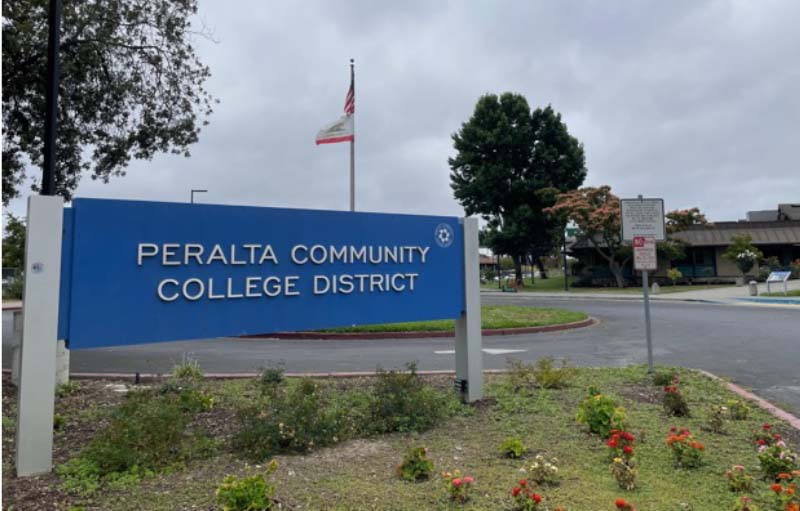
But convincing districts to take advantage of the new legislation hasn’t always been easy. At the Peralta Community College District, the process took months.
“It took longer than it should have,” said Jeff Sanceri, president of the Peralta Federation of Teachers, the district’s faculty union. “It should have been a really, really easy get.”
Despite pleas from faculty to accept the new state funding, the district had fiscal concerns.
“If the District were to agree to pay for part-time faculty health insurance, and then does not receive full state reimbursement due to lack of funds this year or in future years, the District would be required to cover significant costs that have not been budgeted,” wrote Peralta’s interim chancellor Jannett Jackson in an update posted online to the district community.
Faculty, though, had stated that they were willing to renegotiate if the funding was reduced, eliminated or insufficient.
According to Jennifer Shanoski, then-president of the faculty union, the district proposed that it would seek the funds only in exchange for “some serious concessions to current full-time faculty rights,” such as increased control over whether courses are in person or online.
“They’re trying to trade non-monetary, like non-budget issues for a monetary issue that will actually save them a significant amount of money,” Shanoski said.
District leaders eventually changed their minds and agreed to provide 100% covered health insurance to part-timers. The tentative agreement addresses PCCD’s concerns about the reliability of the funding.
“Our agreement is contingent on the state providing the same or greater level of financial support for the program as is available currently,” wrote Jackson in another update.
Sanceri said the tentative agreement would likely be finalized mid-August.
For one part-timer coming up on her 20th year teaching English for speakers of other languages at Laney College, fully covered health insurance would be a relief.
“I would be able to breathe,” she said. “I wouldn’t have to go into savings. I wouldn’t have to try to pick up money tutoring. It would just be a relief, a very big relief.”
Faculty at other districts have yet to feel relief. San Mateo Community College District faculty members have been pushing for this issue for months.
San Mateo’s part-time faculty receive $3,305 per semester for health care premiums.
“It’s not really sufficient, given how expensive health care is,” said Marianne Kaletsky, the executive director of the San Mateo Community College Federation of Teachers.
For instance, for a Kaiser plan that costs $914 per month, full-time faculty pay $39 per month. The part-time stipend brings adjuncts’ out-of-pocket monthly payment for the same plan to $363.

Another problem with this system is that the stipend is paid out at the end of the semester instead of monthly, which can place financial hardship on faculty, Kaletsky said.
“It’s like, do I pay rent? Or do I take my kid to the ER? Those are real-world situations that a lot of people are dealing with,” said Perkins, the adjunct educator who teaches at multiple colleges in the district.
“The first time I even have a possibility, I want to say, of having healthcare through my employer in a long time, our college is not doing it,” she said.
The district cites conflicts between the state requirements and the requirements of the California Public Employees Retirement System, through which full-time faculty receive their benefits. According to district spokesperson David McLain, the district cannot meet the conditions necessary to get reimbursed under the state with the current regulations from CalPers.
McClain added in an email, “a decision to shift the district to an alternate benefits provider is a proposition that would require careful planning and agreement from other campus stakeholders.”
Amid negotiations that have been ongoing since May 2022, the district’s current offer intends to increase the stipend available to part-timers, equivalent to the rate of a Kaiser plan for a single person. But faculty say this won’t help cover the dependents of part-timers or address the problem of faculty waiting months to get reimbursed for their costs.
Faculty continue to mobilize, urging the district to further improve the health care options for part-timers in line with the state program requirements.
“To be placed in that position to think twice to go to a doctor and take care of their health,” said Venkataraman, “that is inhumane.”


 Bay News Rising
Recent Comments