
Bay News Rising
Professional and college reporters training collaboratively for the future of Bay Area journalism. Bay News Rising is a project of the Pacific Media Workers Guild made possible by the labor and contributions of its members.
Afghan journalists fled for their lives as the Taliban came to power. Two women tell their stories.
By Simmerdeep Kaur ::
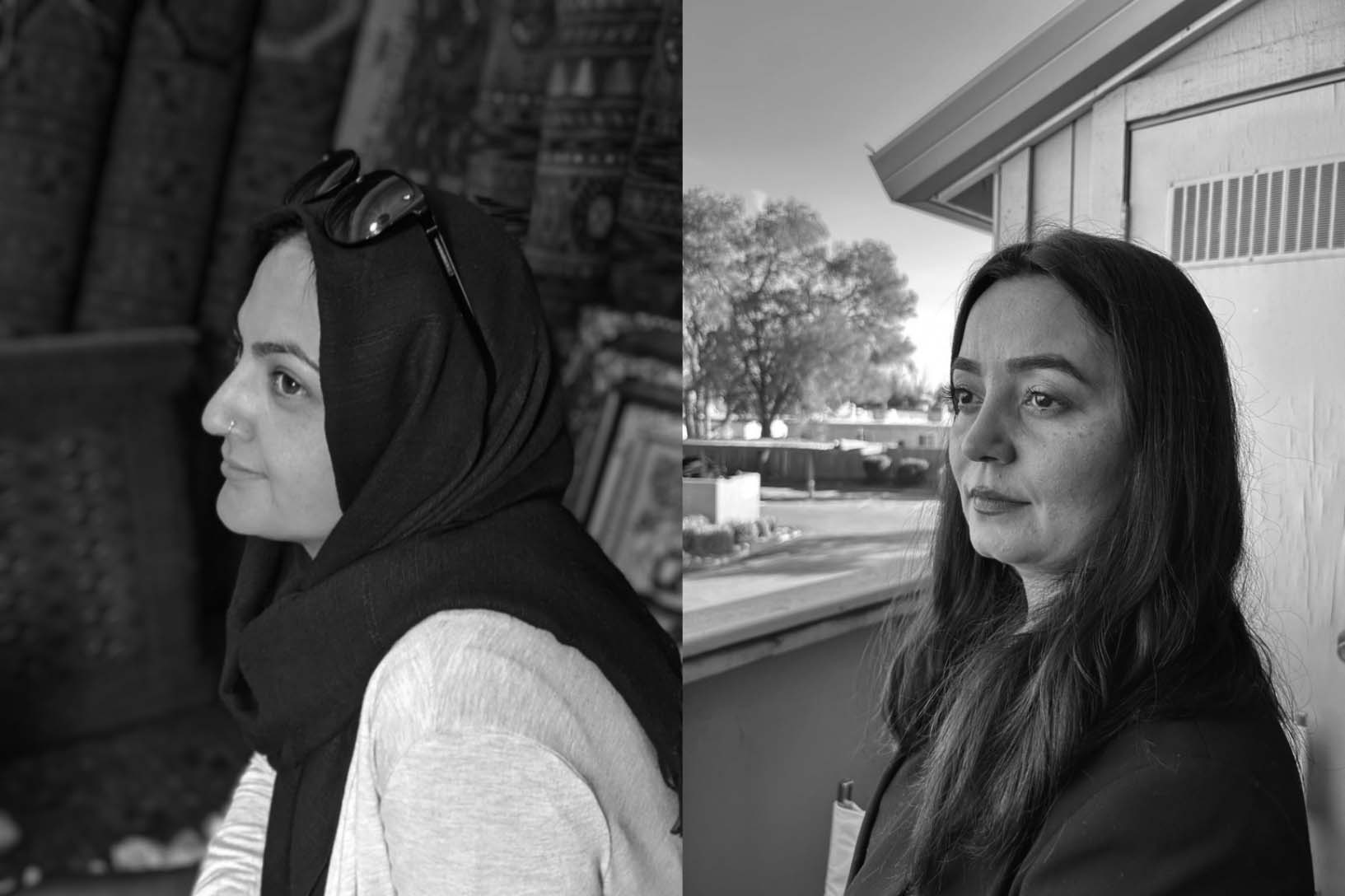
As Afghanistan fell to Taliban control in the summer of 2021, the lives of two female journalists changed forever, their fates intertwined by the prospect of exile.
Lina Shirzad fled for her life in August after insurgents said they would kill her when Kabul province fell. Khwaga Ghani hid for four days, then slept on an airport runway for two nights as she waited for an evacuation flight.
Both escaped and are living in Northern California. But neither is living the life or career she dreamed of when freedom for women seemed possible in a nation recovering from decades of war.
For Shirzad, exile means separation from her family with no expiration date. “I just want to meet my mom once, and give her a big hug,” she said.
Ghani’s family joined her in California, but she misses her homeland and mourns the life she had dreamt of. “I had so many plans for my life and for my future that I’d be reporting from Afghanistan. I’ll have this career and I’ll be working with NPR for a long time, and I probably will get married. But everything collapsed,” she added.
In one sense, they were fortunate. According to data collected by the Committee to Protect Journalists, at least 79 journalists were executed in Afghanistan between 1992 and 2023, a tally exceeded by only nine countries. Although there’s no exact tally, it’s known that many more journalists had to flee their motherland due to ongoing threats of violence.
In the end, many wish for the same thing: to go back home.
Shirzad’s and Ghani’s stories reflect a setback not only for female journalists but for their country and democracy as well.
“Everything that is happening at the moment paradoxically makes the (journalism) profession all the more important,” said Anna Brakha, a Europe and Central Asia researcher with CPJ. These journalists come from different backgrounds but all have met the fate of either execution or exile.
Ghani was born in the Wardak province in central Afghanistan in 1984. Her family was one of the country’s most influential.
But the country was becoming increasingly unstable and dangerous as the Taliban gained strength. In 1990, when Ghani was 6, her family moved to Pakistan, where they lived as refugees. She grew up with her two siblings in Islamabad, the capital, where she attended school and university.
Afghanistan was in the midst of a civil war sparked by the fall of the Soviet-backed government in 1992. By 1996, the Taliban had captured Kabul and dominated approximately three-quarters of the country. Their harsh, misogynistic rule lasted until 2001, when the United States invaded and drove the Taliban from power in the wake of the 9/11 attacks.
The war devastated Afghanistan, but the liberalization that followed the invasion was a stark contrast to the fundamentalist policies of the Taliban. Although progress was uneven, there was growing respect for the rights of women and education spread. Fathers began to understand the importance of their daughters attending school. Daily life became freer as people no longer needed to comply with the stringent application of Shariah law. Inspired by the changes, exiles returned. Ghani’s family was one of them.
“When the U.S. came along, a lot of opportunities came for women,” Ghani said.
Returning to Kabul with her family in 2011, Ghani started her career as an English instructor at a university and later worked as a public relations officer at an independent human rights commission center. In 2015, she started work on a documentary about women’s rights in Afghanistan with HBO’s Vice, where she was a reporter and translator. It was the beginning of her career as a journalist. In 2019, she started working with National Public Radio (NPR) as a stringer, reporting stories for the network’s bureau in Islamabad. Breaking news from Afghanistan was part of her beat.
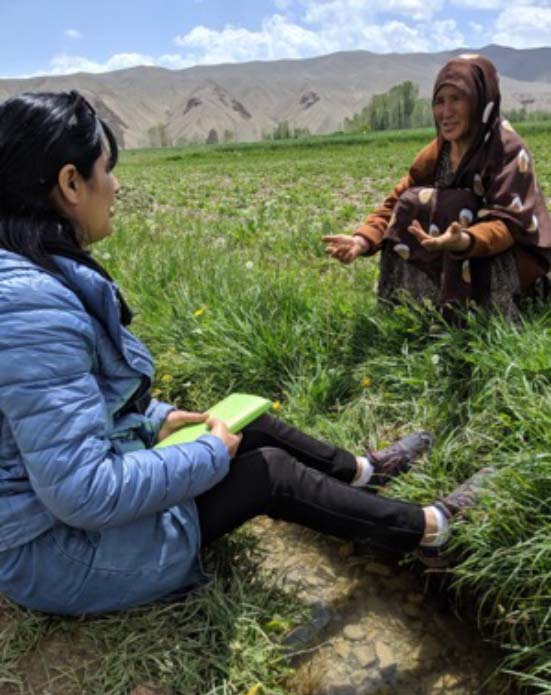
(Courtesy of Khwaga Ghani)
Shirzad grew up in Badakhshan in north-eastern Afghanistan and had been working as a journalist in northern Afghanistan for 13 years.
She was a reporter for the Voice of America, covering the narcotics beat for two years. As she prepared stories, she was often accused of being an infidel. She frequently received threats from Hizb ut-Tahrir, a political organization that – among other groups – disapproved of her relationship with the Americans.
“I was told if Badakhshan province falls, ‘we will not leave you alive,’” Shirzad said.
In 2021, the Taliban retook Kabul. The U.S. withdrew its remaining forces from Afghanistan on Aug. 30. Afghan soldiers abandoned their posts, some surrendered to the Taliban, and President Ashraf Ghani fled the country. The 20-year U.S.-led military campaign in Afghanistan came to an end, and the country was about to go back in time.
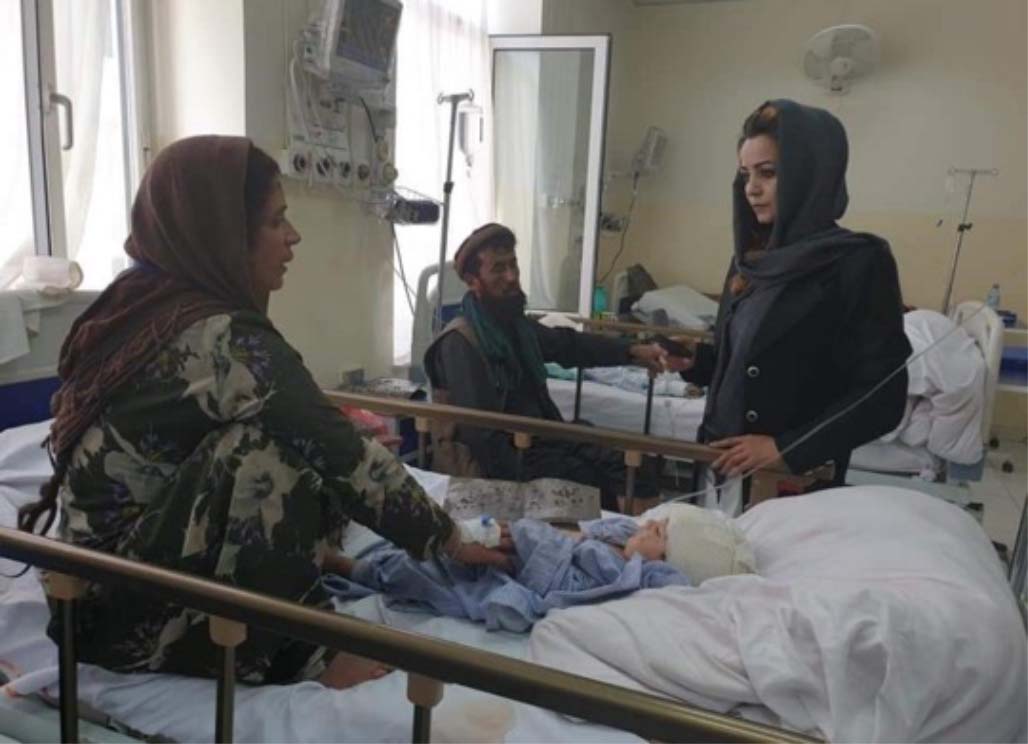
(Courtesy of Lina Shirzad)
When this news broke, Ghani was working with Amnesty International on a report about war crimes. Her fellow researcher at the time, who had come from New York, immediately rushed to the airport. As for Ghani, she went back home and stayed indoors for four days. She was desperate for any opportunity to escape with her family because she knew home wouldn’t be safe much longer.
Meanwhile, citizens who came to Kabul from other provinces hoping to find safety were panicking. When theTaliban seized her hometown on Aug. 11, Shirzad fled to Kabul and stayed at the Afghanistan Journalists Safety Committee’s shelter.
During that time, the executive director of Nai, a non-governmental organization advocating for open media in Afghanistan, held a meeting with several journalists in Kabul. The director remarked that the provincial capitals had fallen, which is why everyone came to Kabul. He then asked the journalists what they were planning to do, now that Kabul was falling. The question stunned everyone in the room to silence, including Shirzad.
After the meeting, Shirzad was in her room at the shelter when Journalist Safety Committee staffers informed her they could no longer take responsibility for her safety and advised her to find protection elsewhere. Shirzad was a well-known public figure. She was afraid that if she went to friends’ homes, the Taliban might harm them. She had no money with her.
“I eventually made the decision to go to someone’s home. I got in a taxi four times but was so distracted that I got out of the taxi each time. That moment is forever etched in my memory and I will never forget it,” she said.
In the same city, after almost 100 hours of staying shut in her house, Ghani received a call from a friend at Vice News. He connected her to a coordinator who was escorting journalists to a safehouse in Kabul. Ghani and her family left immediately. They had neither time nor space to carry luggage.
“When I left home, I had one carry-on bag, important documents, two pairs of clothes and that’s it,” Ghani added.
She heard that the Taliban were seizing documents so people couldn’t leave the country. But she also knew the Taliban would not physically touch women. So she hid her documents under her abaya and reached the safehouse with her parents and sister.
The next step was finding a way to fly out of the country. After staying at the safehouse for another four days, she received a call from a friend from The New Yorker magazine, who had chartered a plane solely for journalists that would fly from Kabul to Macedonia and then to the United States.
Ghani arrived at Kabul International Airport with her family. The window of opportunity for people to escape was getting shorter and the airport was getting more crowded and chaotic.
“It was a very bad situation; people were jumping over the walls of the airport,” Ghani said.
Her family spent two nights at the airport, sleeping on the runway, until learning that the plane chartered for them had been occupied by the wrong people. About 150 Afghan civilians had boarded the flight and refused to get off despite the pilot’s instructions. The plane stayed on the runway and nobody got off. After two days, the pilot was compelled to take off.
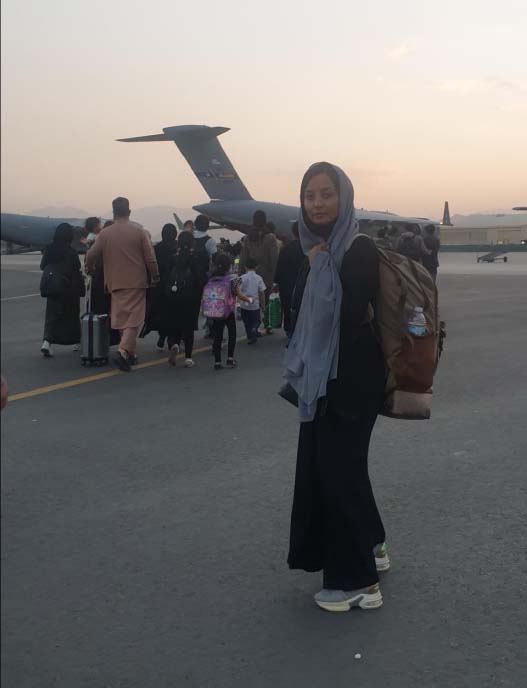
(Courtesy of Lina Shirzad)
Shirzad, meanwhile, had already been on the run. After several days, a source informed her that her name was on a list of journalists to be evacuated from the country immediately. She was taken to Kabul Serena Hotel as a part of this evacuation program that was taking place through the non-governmental organization Sayara.
Shirzad went to the airport in a minibus with other journalists. As the bus approached the airport, Shirzad could see people spending the night behind the airport gates, desperate for even a sliver of an opportunity to enter and get out of the country.
Shirzad’s eyes focused on the bus window, but her mind was elsewhere, speeding through the same thoughts over and over. “What will I do where I’m going now? Who is there, who am I facing, how will the environment be? What about my goals and dreams?”
The evacuees were to fly from Kabul to Qatar and eventually to the United States, Shirzad’s only chance to escape. But it meant leaving without saying goodbyes. When she left for Qatar, she could not inform her family about her departure. During a connecting flight from Qatar to Italy, she called her elder sister to break the news.
“If I were there, my family’s life would be in danger and I would create problems for them. And I would lose family members due to my presence (in Afghanistan),” Shirzad said.
In the four months that followed, Shirzad’s mother had still not recovered from her daughter’s absence. Her mental condition worsened, landing her in the hospital. Shirzad had left to protect her loved ones. Yet the circumstances did not allow her to do much for her mother during these times.
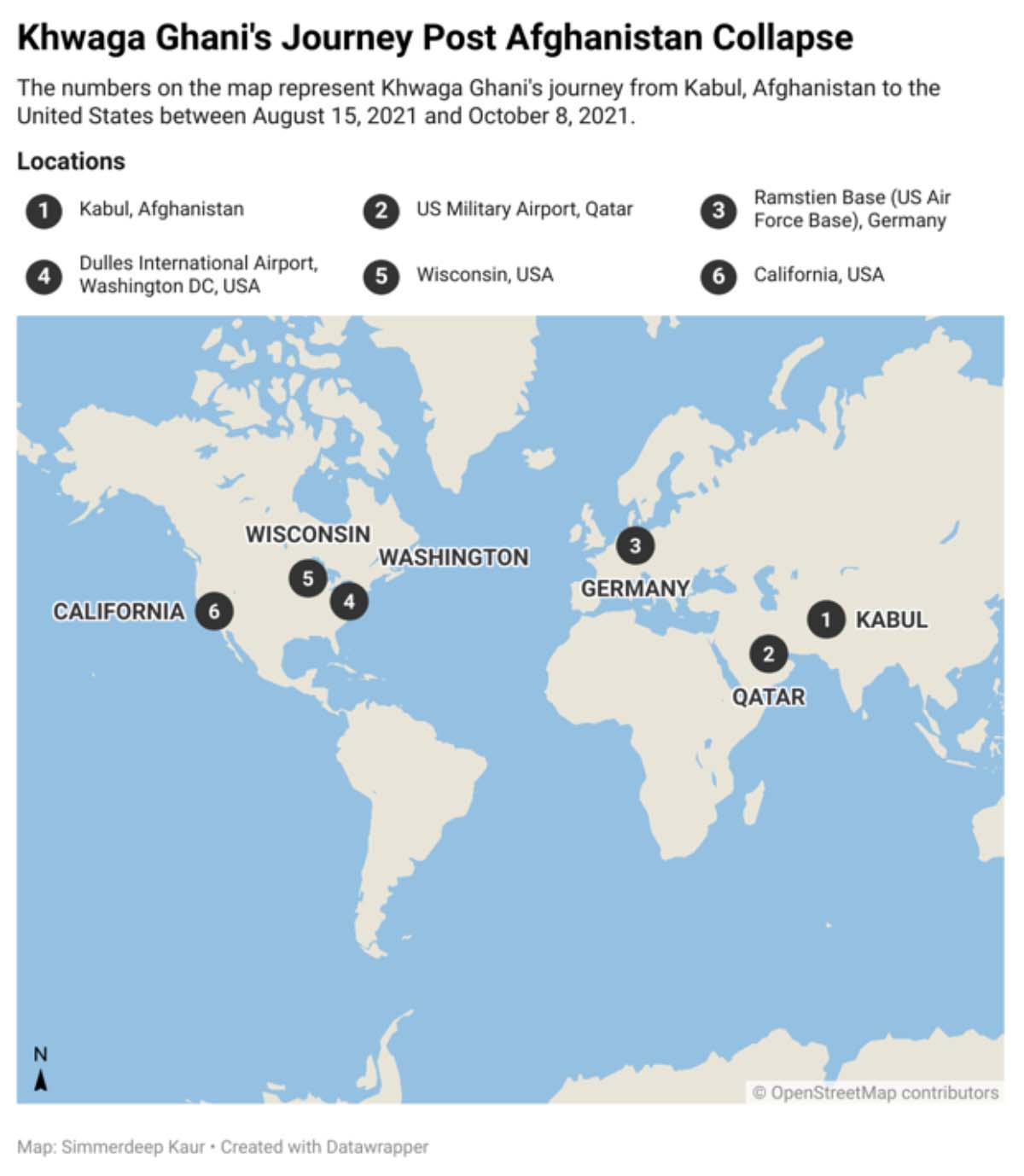
Back at Kabul International Airport, Ghani was getting more anxious about her family’s safety. They could not stay at the airport much longer and could not go back home. After seemingly endless hours of wait, Ghani and her family were able to join a line of evacuees for a U.S. military plane flying 500 people. Finally, they landed at a U.S. military airport in Qatar. After one day, the same plane flew to a U.S. Air Force Base in Germany, where the refugees stayed for four days and nights.
“We didn’t know what was going on, actually, because nobody would tell you the next step,” Ghani said. She kept asking the soldiers where the plane was traveling next. “Get on the plane, you’ll know where you’re going to land,” they would reply.
They got an answer as they left Germany. They flew to Washington, D.C., and later stayed at a military camp in Wisconsin, where their official documents were processed. They bought tickets for California, where Ghani’s brother had been living for four years. Her mother’s side of the family also was living in the Bay Area.
Ghani’s entire family reunited at San Francisco International Airport. The journey there from Kabul had taken nearly three months, but some of the kin had not seen each other in 40 years.
Today, Ghani is a student at the UC Berkeley Graduate School of Journalism and lives in Fremont with her family.
Shirzad lives in Sacramento and works as a videographer in a production company and at a restaurant packing food orders.
Ghani and Shirzad had worked for years, establishing their careers and becoming a voice for women in Afghanistan. Now, they must start their lives anew at the age of 40 and 30.
“When you took over, you started something. Finish it,” Ghani said, referring to the U.S. invasion of Afghanistan. “And now we have nothing in the country. Nothing. It’s just darkness.”
Ghani and Shirzad have never met. They lived in different cities in Afghanistan and live in different cities in Northern California. Yet they face similar struggles every day. They have to communicate in a language not their own and adapt to a culture vastly different from their own.
“My friends call and say that you went to America, you should be happy, and have fun, but it’s tough (to be happy),” Shirzad said.
Ghani and Shirzad wish for only two things: to resume reporting for Afghanistan and to return home.
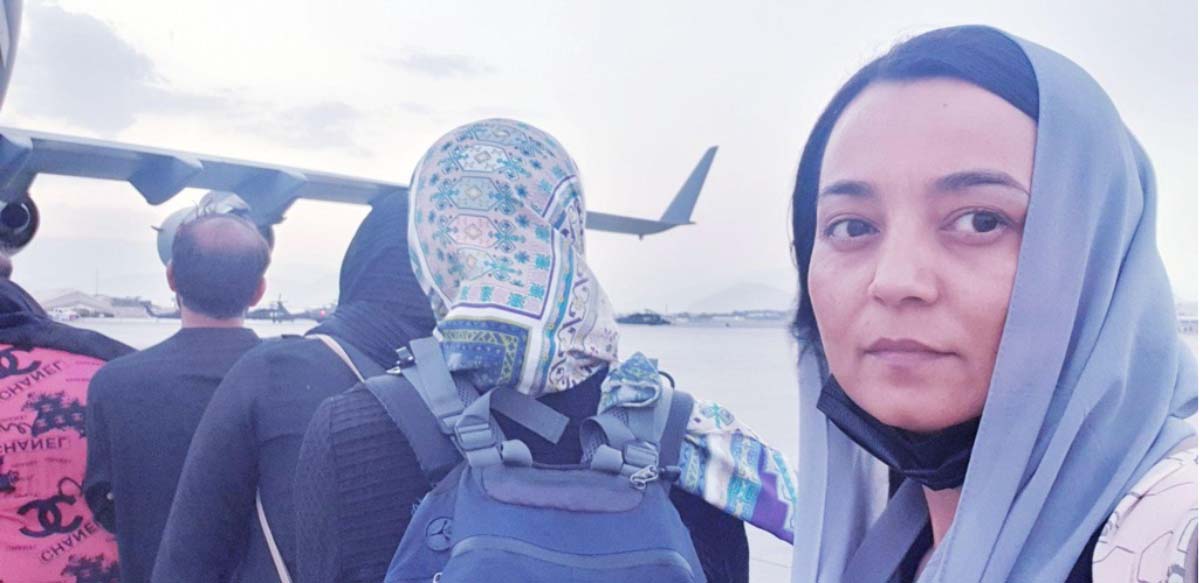
Lina Sirzad at Kabul International Airport


 Bay News Rising
Recent Comments