
Bay News Rising
Professional and college reporters training collaboratively for the future of Bay Area journalism. Bay News Rising is a project of the Pacific Media Workers Guild made possible by the labor and contributions of its members.
Beyond the lobby
By Marrion Cruz
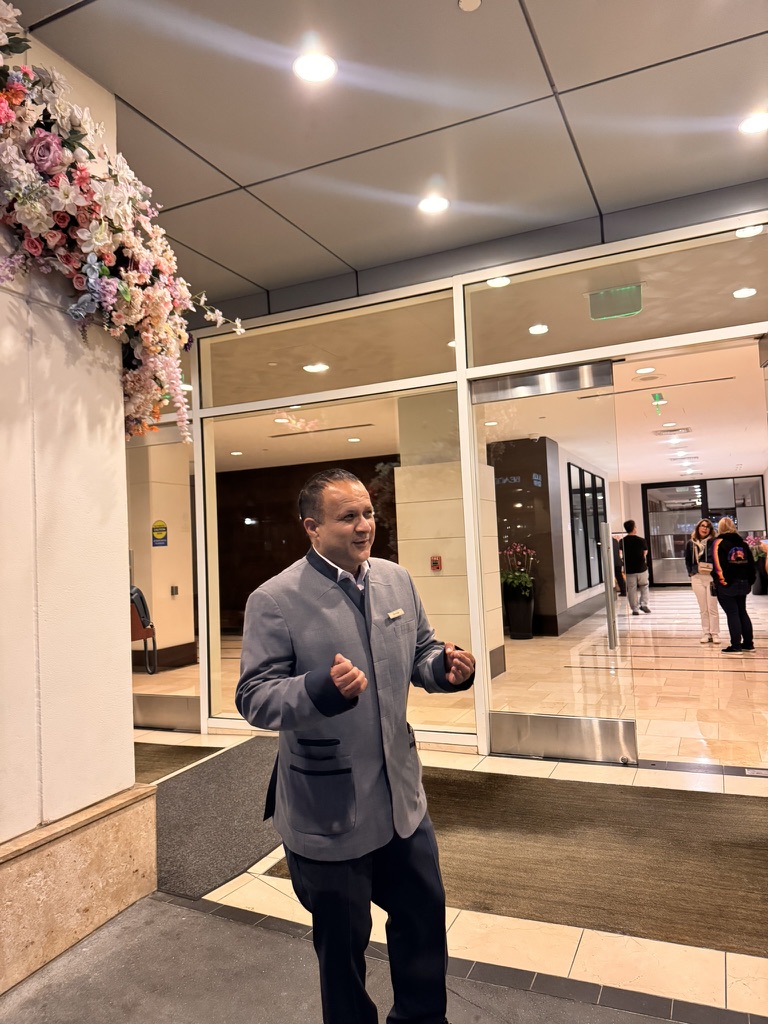
The lobby of the San Francisco Marriott Union Square Hotel is buzzing on this mid-July morning. Guests are checking in; other guests have checked out but are waiting with luggage, children, rides, shuttles, lunch plans or a last walk in the city.
Dhruba Neupane, a 55-year-old bellhop, is helping guests check out. A guest from New Jersey calls Neupane his “cousin” and thanks the veteran hotel worker for recommending a nearby dive bar.
Another “resident” guest — one of those who visit often enough to call San Francisco home-away-from-home — hugs him warmly before leaving the lobby and striding to a nearby car for a ride around town.
Neupane, a native of Kathmandu, Nepal, has worked at the hotel for seven years. Since then, his job has become a lot tougher. He greets guests, lifts luggage and performs myriad duties once divided among at least three workers at the front door.
“Now, I am all-the-man,” he says.
He pushes a luggage cart deeper into the hotel with one hand, the other waving animatedly to a friend.
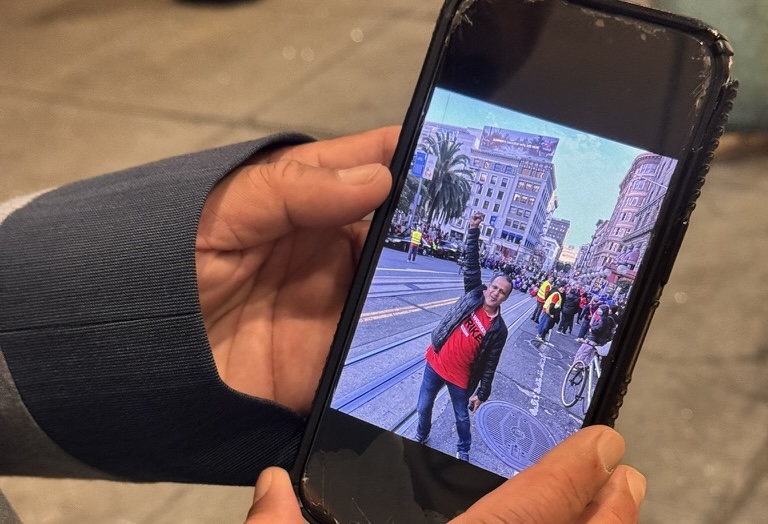
He takes out his iPhone and shows a picture of himself on Powell Street, fist up alongside coworkers on a picket line.
Neupane was one of more than 2,000 hotel workers who struck in 2024, declaring, as one union slogan put it, that “one job should be enough.” The strike won higher pay, protected health care and stronger staffing rules as San Francisco’s tourism industry, flattened by the COVID-19 pandemic, works to rebuild itself. Nearly two years later, though, Neupane still lacks enough scheduled hours at one union hotel to support his family. He works a second job, as a bellhop at the Grand Hyatt Regency, to make up the difference, highlighting a gap between what the new contracts promised and the industry’s recovery.
In another video, the place he usually carries bags had become a walkout site. Wearing red and holding a megaphone, he helped lead workers in a chant outside the building where he has worked for six years.
Neupane is a member of Unite Here Local 2, which led the strike and represents more than 15,000 hospitality workers in the Bay Area.
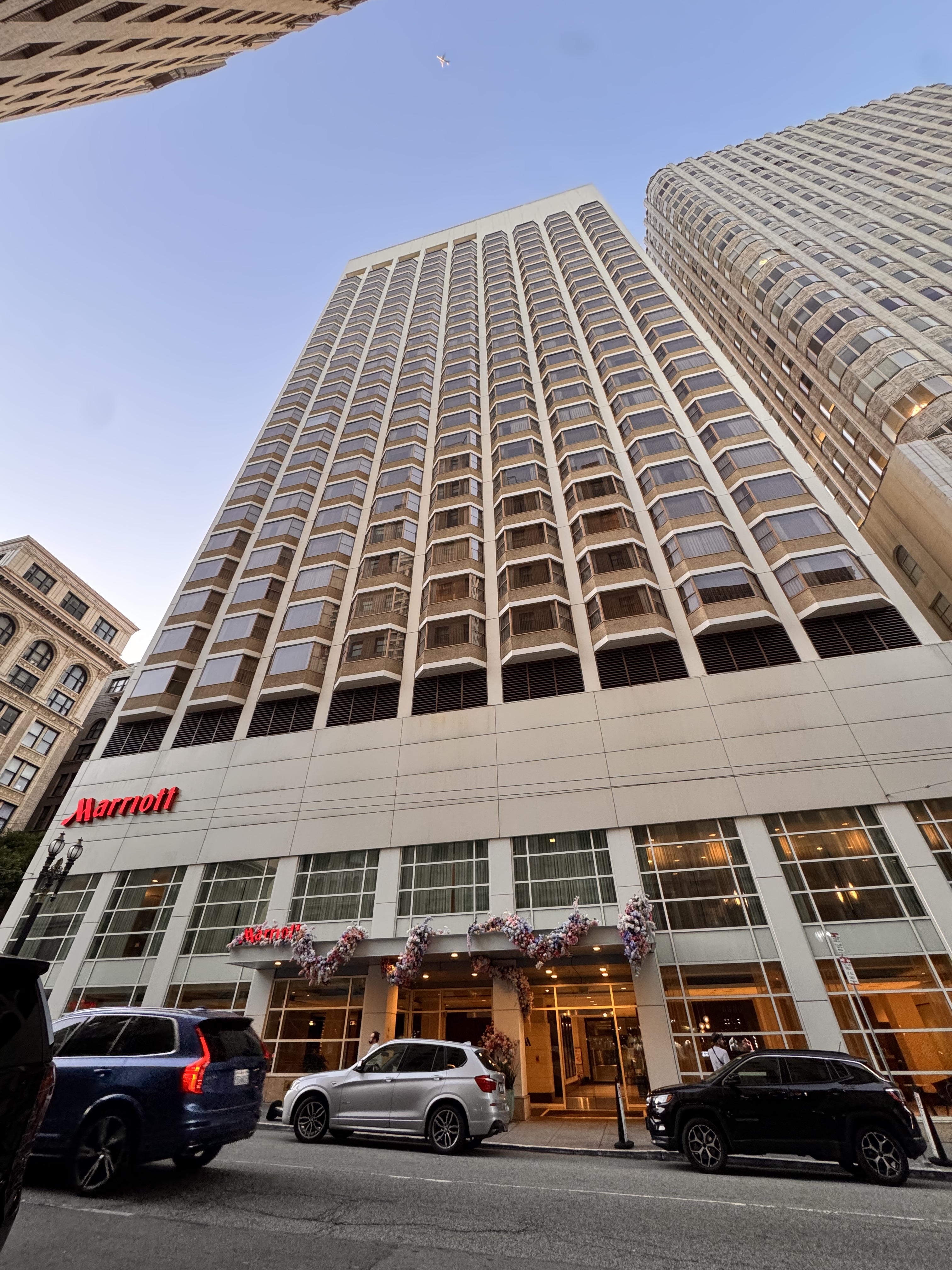
After months of negotiations, the strike began on Sept. 22, 2024. It grew from roughly 1,500 to 2,500 workers and targeted the SF Marriott Palace Hotel, SF Marriott Marquis, SF Marriott Union Square and Westin St. Francis.
Spirited picket lines and marches kept the strike in the public eye and gained support of some labor-friendly city officials.
On Oct. 8, 2024, San Francisco Board of Supervisors President Aaron Peskin convened a special board meeting for striking hotel workers to testify. Supervisor Hillary Ronen told hotel owners, “You’re not going to continue to operate in San Francisco if you don’t respect our laws and respect our workers.”
Hotel guests, many of whom had likely made reservations long before the strike, crossed picket lines. But they did not face workers’ hostility. “We were still opening doors and being friendly,” Neupane said.
The strike ended a few days before Christmas. The new contract delivered an immediate $3 per hour wage increase with an additional $3.50 per hour in annual raises through 2028 for non-tipped workers. It also preserved the union-administered health insurance plan, increased monthly pension benefits, preserved retiree health care, and strengthened protections against understaffing and workload increases.
“The striking workers won a great contract after a long, hard fight during a challenging time in San Francisco’s tourism economy,” said Sonya Karabel, a campaign researcher for Unite Here Locals 2 and 40. “The hotel workers who went on strike set a strong standard for hotels across the Bay Area and since ratifying those contracts, we have won very similar contracts at the majority of Local 2-represented hotels.”
The pandemic and the growing work-from-home trend battered San Francisco’s economy. The tourist economy, though, is showing signs of recovery. For 2026, San Francisco Travel projects 24.2 million visitors, $9.9 billion in visitor spending and 674,000 room nights tied to Moscone Center events.
Despite the uptick in business for the hotels, the number of guest service agents at Neupane’s job is still decreasing per shift; there used to be a doorman, a bellhop and a valet on every shift when he’d started in 2025.
During the negotiations and subsequent strike, Local 2 officials argued that Marriott could well afford to spend more on its workforce. A look at the company’s most recent quarterly earnings supports their argument.
In the first quarter of 2026, the company reported net income of $648 million, a slight decrease from the previous year, but operating income was up 12 percent and revenue per room, an important metric, was up 4.2 percent.
The company also repurchased $700 million of stock during the quarter and said its worldwide development pipeline, that is, plans to expand, reached a record level. According to Marriott’s website, the Maryland-based corporation plans to add 618,000 rooms worldwide.

Before she retired, Tess Fortes was out of bed and out of her Geary Street apartment by 5:30 in the morning. She’d walk down Market Street toward her job at the Marriott Union Square.
But she retired in 2025 from the housekeeper job she’d held for more than a decade and her life is now very different. Her brother died last year and she tries to find things to do, visiting friends and attending mass.
She often remembers her life decades before moving to San Francisco. She worked as a production operator at Motorola in the Philippines and completed a secretarial course from Gregg Business College. Her parents moved to San Francisco in the early 1990s; Fortes followed in 2012.
Now retired, she receives two pensions, “salamat sa union,” (“thanks to the union”). Her union, Unite Here Local 2, helped pay expenses related to becoming a citizen; she received a Green Card in 2012.
She spent about six hours a day on the picket line, a stretch similar to her normal working hours. She and her coworkers received strike pay of $500 a week, enough to live on during the 93-day work stoppage. It was a lot of walking but in some ways being on strike “was fun,” she said.
When Fortes started at the Marriott in 2013, she received $20 an hour but had no set schedule. “There were weeks I waited” to be called into work, she said, and at times she wouldn’t receive a paycheck for weeks.
Each housekeeper was expected to clean at least 14 rooms per shift. “If you finished early, then you kind of hang out until your shift is over so you get your eight hours.” Spending time with co-workers made her feel she was part of a community.
By the end of 2025, she received $33 per hour, far above San Francisco’s minimum wage of $19.61 per hour.
A strong hourly rate cannot guarantee security when a worker receives too few hours, supports several dependents or must combine jobs to preserve income and benefits.
Neupane, who lives in Alameda, arrived at the picket lines as early as if he were reporting for work.
He didn’t set out to be a hotel worker but is familiar with hospitality management. Before leaving Kathmandu, he owned a nine-room hostel called La Casa. After arriving in San Francisco in 2019, he operated a yoga studio in North Beach for 13 months.
“I do it all for my kids,” he said. Healthcare benefits were critically important to him; he wants to keep his kids covered until they reach 26. He has 16-year-old twins and an 18-year-old who hopes to go to a community college.
Fortes’ wages rose, too, and her health care coverage continued while she earned a pension. After the strike, she said, she was happy she received her pay raise because $3 per hour “can go a long way.” She and her sister split expenses and share the rent on the apartment Fortes has lived in since 1997. Her brother, Renato Isla Fortes, started as a front desk agent in 2020 at Marriott Union Square, and progressed to night audit and then to accounting before he died in 2025.
But whether those benefits amount to a secure retirement depends on a worker’s ability to make do: living in a too-small or older apartment, shared household costs, careful budgeting and the possibility of eventually leaving San Francisco.
Fortes said she hopes to retire in the Philippines with her sisters and brother but has no concrete plans. In the meantime, she said, she spends time with her friends.
For immigrant workers concentrated in physically demanding jobs, advancement may depend on English fluency, computer knowledge and access to training — preparation not equally available during or outside working hours.
“Saka pag marunong kang mag-English,” Fortes said, meaning that if you know how to speak English it’s easier to move up in the company. She took ESL classes at City College of San Francisco’s Downtown Center in 2012.
San Francisco’s visitor economy depends on workers who are often forced to work multiple jobs, share housing and endure lengthy commutes. And when they contemplate retirement, many who have served the industry for decades fear the high cost of living will force them to leave San Francisco.
In 2024, Neupane stood outside the entrance of the Marriott with a megaphone. Now he was back beneath the hotel lights, lifting luggage, calling cars and telling visitors where to go next. By morning, he would be on his way to another hotel. At the Marriott, another shift would take his place, and the entrance would again look welcoming.


Recent Comments